







“Meditations on the Abyss”
Written by J. Michael Staczynski
Directed by Michael Vejar
Season 5, Episode 14
Production episode 515
Original air date: May 27, 1998
It was the dawn of the third age… Delenn’s insomnia is interrupted by a signal from Lennier. She waits for him in a nightclub in downbelow, pausing to break the finger of a guy hitting on her while she waits. Delenn has summoned Lennier back to B5 in secret for a mission so clandestine only the two of them know about it—she hasn’t even told Sheridan of it. They need evidence of the Centauri’s responsibility for the attacks on cargo ships, and she wants Lennier to find it. The secrecy is to avoid leaks. His cover will be an assignment to White Star 27 for a training mission, as they’re detached to the Centauri border.
Vir arrives in Mollari’s quarters with a huge bag of groceries. Mollari’s bug detector finds a listening device attached to the bag he got from the Drazi fruit merchant. After saying some pointed words about the Drazi ambassador’s wife’s sexual prowess before destroying the bug, Mollari informs Vir that, when Mollari is made emperor, Vir will be the new Centauri ambassador to B5.
Lennier reports to Captain Enrique Montoya on White Star 27, which Montoya has rechristened Maria after his late sister. Lennier meets his fellow trainee, Findell, who has nothing but praise for Montoya.
On B5, the Drazi ambassador crankily reports another attack on their ships, and they have a hypothesis as to who’s responsible, and that it’s someone important in the IA. Sheridan says that they’re waiting for proof, not conjecture, but they are leaving no stone unturned. Mollari shows up and makes some snotty remarks to the Drazi ambassador, then leaves in a huff.
On Maria, Montoya assigns Lennier and Findell a mission: to take two fighters and scout the area. They do so, and both trainees are rather shocked to see that they only have an hour of air left—they both checked the tanks before disembarking, and they read full, but now they don’t. And right after that, Maria jumps into hyperspace. They are, in a word, fucked unless Maria returns in the next hour. Lennier recommends that they both go into meditative trances to slow their breathing and heartbeats to make the air last longer. Findell proves not very good at that…

On B5, G’Kar’s Narn prosthetic eye has finally shown up, and Franklin installs it. G’Kar is thrilled to see two red eyes looking back at him in the mirror. Franklin also asks if he can sit in on one of G’Kar’s discussions—as a Foundationist, he’s always interested in new viewpoints on religion. G’Kar agrees, though he doesn’t think Franklin will get much out of it—mostly because G’Kar himself is only doing these sessions reluctantly.
At that session, G’Kar answers a rather stupid question—“What is truth? What is God?”—with a complex answer involving lights shining on walls and such. It’s a nice little metaphor for life’s struggles—and then the guy asks again, “What is truth? What is God?” G’Kar gives a simplistic nonsense answer that’s right out of the Vorlon playback for cryptic and annoying answers to questions, and then people are all satisfied. G’Kar and Franklin exchange a glance of mutual amusement and frustration.
Maria returns before the hour is up. Lennier did the right thing; Findell panicked. Montoya debriefs them, making it clear that Lennier was the one who succeeded in the mission.
On B5, Vir confronts the fruit vendor, who brushes Vir off, saying he’s known far and wide as being weak and spineless. Vir seemingly slinks off, but then returns to Mollari’s quarters, grabs a sword, and returns to the Zocalo and starts angrily trashing the fruit stand. Mollari follows and watches, declaring to a gobsmacked Allan that now Vir is ready to be ambassador.
On Maria, Montoya has a new training mission for Lennier, Findell, and two other trainees: an Easter egg hunt. They have to go into an asteroid field and each find ten beacons that have been hidden throughout it. However, there are only 39 beacons, so someone is going to fail.
Findell then confides in Lennier that he never wanted to be a Ranger, but he joined up because two of his family members were Rangers, and they died in the Shadow War. Lennier points out that that’s a really bad reason to join the Rangers—you should do it because you want to, not because you feel obligated to.

The Easter egg hunt starts, but Findell starts to lose it. Lennier realizes that he’s set a course to crash into one of the asteroids. He tries talking Findell out of it on a private channel, but Findell is determined. Lennier overrides the targeting system and manually fires on Findell’s fighter to knock him off course.
Back on Maria, Lennier concocts a bullshit story about equipment failure to protect Findell. Montoya declares Lennier a failure in the mission and gives Findell a neutral grade, as he didn’t get to finish the assignment. He also has decided that Findell’s best place to be is in recruitment—it will be his job to make sure that all new recruits really really want to be Rangers. After Findell goes off, Montoya privately thanks Lennier for what he did and also reminds him that White Stars can listen in on any communication between fighters, even “private” channels.
Sheridan, Delenn, Allan, and Franklin share a meal. Allan tells the story of Vir’s going medieval on the fruit vendor, and how Mollari was like a proud father watching it. Sheridan says he’s almost sorry Mollari found the bug, but Delenn doesn’t think that Mollari has anything to do with this. Most likely it’s the Regent and/or other members of the court.
There’s also an empty seat at the table, which was supposed to be for Garibaldi. We cut to his quarters to see him very very drunk, singing “Show Me the Way to Go Home” and ordering a pizza.
The household god of frustration. Garibaldi got a coffee cup stain on G’Kar’s manuscript. Because Narn tradition is that all copies of a book are facsimiles of the original manuscript, there’s a brown circle on one page of every copy of The Book of G’Kar.
Also, Garibaldi’s now getting seriously drunk.
If you value your lives, be somewhere else. Delenn’s plan to get information about the Centauri without any leaks is to make use of Lenner’s dedication.
In the glorious days of the Centauri Republic… Vir is now in line to take over as ambassador. Considering he’s already been Centauri ambassador to Minbar, this isn’t really a big stretch, but whatever.

Though it take a thousand years, we will be free. Narns are apparently like humans in that they prefer short pithy platitudes to philosophical musings.
We live for the one, we die for the one. Ranger training can be really really mean…
Looking ahead. Lennier mentions the prophecy he got from Morden’s ghost that he’d betray the Rangers. Delenn finds that impossible to credit. She’ll be proven wrong, and Morden right, before too long.
No sex, please, we’re EarthForce. It is very obvious that, when Delenn meets Lennier secretly without Sheridan even knowing about it, that he thinks it might possibly be a booty call, and he’s obviously very disappointed to realize that it’s “just” a Ranger mission.
Welcome aboard. Richard Yniguez makes the first of two appearances as Montoya; he’ll be back next time in “Darkness Ascending.” Ron Campbell is back from “Rumors, Bargains, and Lies” as the Drazi ambassador; he’ll next be seen in the movie A Call to Arms. Martin East plays Findell, Mark Hendrickson plays the clueless Narn, and the late Carl Ciarfalio—who played the Thing in the never-released Roger Corman-produced 1994 Fantastic Four film—plays the Drazi fruit vendor.
Trivial matters. Franklin was established as being a Foundationist in “In the Shadow of Z’ha’dum.” The Book of G’Kar was established as a publishing sensation, and G’Kar revered as a prophet of sorts, in “The Ragged Edge.” G’Kar’s eye was removed by Cartagia at the end of “Falling Toward Apotheosis.” Lennier left B5 to join the Rangers in “The Very Long Night of Londo Mollari.” He met Morden’s ghost in “Day of the Dead.” Garibaldi got back on the proverbial wagon in “Phoenix Rising.”
The echoes of all of our conversations.
“I was beginning to wonder if you were going to make it, Lennier.”
“I said that I would never leave you, that I would be here when you needed me most. Tell me what you want done. I will make it happen, no matter the cost.”
—Delenn welcoming Lennier and Lennier overdoing it a bit.
The name of the place is Babylon 5. “Wanna finish our little conversation, spoo-for-brains?” In all honesty, this is the first episode in this rather dreary final season that really feels like an episode of Babylon 5. Now to be fair, for some of the prior episodes that didn’t so feel, that was a feature, not a bug—“A View from the Gallery,” “Day of the Dead,” “The Corps is Mother, the Corps is Father”—but for the rest, things have just been off. Part of it is the lack of Ivanova; a big part of it is Byron sucking the air out of the room in every episode he was in. And the first episode after Byron’s welcome departure was the victim of poor directing.
This one, though, just feels right. It helps that the guest casting, which has been a hit-or-miss proposition on this show since the beginning, absolutely nails it here. Richard Yniguez is brilliant as Montoya, whom J. Michael Straczynski writes superlatively as a teacher and mentor. He handles Lennier and Findell perfectly, and that entire storyline works very nicely. I especially like the compassionate solutions that both Lennier and Montoya employ, attempts to save a life and also save face for everyone.
G’Kar’s exasperation with being a major religious figure continues to be a strong storyline, as he’s frustrated, not just by the fact that everyone wants to hear what he has to say, but that most of what he’s saying is going right over their heads. Both Andreas Katsulas and Richard Biggs—watching from the doorway—play it very well. (The shrugging smile Franklin gives G’Kar at the end speaks volumes.)
Vir has had basically nothing to do since the end of the Shadow War, so it’s nice to see him have his crowning moment of awesome here.
Having said all that, man these storylines are dragging. Part of it is the hangover from the balls-to-the-wall action of season four, but it feels like it’s taking forever to get through some of these plots. This is the third episode (after “Phoenix Rising” and “The Ragged Edge”) that has had Garibaldi’s drunkenness played like it’s a big revelation, without that thread moving at all. The cargo ship attacks feel like they’ve been going on for several ice ages without much forward movement, and I’m pretty much at the “get on with it!” phase with a lot of it.
Next week: “Darkness Ascending.”

Delenn comes off very badly in her scene with Lennier. She has to be at least somewhat aware of his feelings, and she seems to be deliberately tugging on those threads. It feels very manipulative and keeps him thinking he might have a chance if only Sheridan weren’t around.
I don’t quite agree that Garibaldi’s thread is moving too slowly. He started drinking again right at the end of “Phoenix Rising” in a very well-played scene. In “The Ragged Edge,” he almost steps back from the edge before drinking himself into a stupor in a social situation. Now, he’s sitting in his room and getting blasted all by himself. It’s a more realistic progression than back in Season 2 when he went all the way in one fell swoop. And it gives Jerry Doyle something to do so that he can appear in the contractually agreed number of episodes this season.
(Also, Garibaldi fell off the proverbial wagon in “Phoenix Rising” not got back on.)
My only thing with the Garibaldi arc is that I feel like someone should have checked on him by now. They knew something was up in “Phoenix Rising”, and he’s been acting strangely and sometimes absent since then. At the very least, Franklin should have checked on him. Regardless of how much he said everything is dandy.
I also have to agree with you regarding Delenn. I think she’s incredibly cruel in how she treats Lennier. At the very least, her approach should be clinical and detached. She certainly shouldn’t be caressing his face and setting up late night meetups in Down Below. But I’ve always felt that her reaction to Lennier’s obvious affections were completely wrong.
Wow, it looks like we have completely different opinions of Montoya. I’m ready to nominate him for the sixth entry in today’s Terrible or Useless Mentors column by James Davis Nicoll.
Montoya can clearly see that Findell is struggling, and has supposedly already been teaching him for a while. So instead of taking Findell aside for some remedial work and properly mentoring him, or finding a different teacher for him, he instead choses to traumatize him and Lennier with surprise abandonment and short oxygen. Once Montoya is finished publicly chastising Findell for how much he screwed up compared to the perfect new guy, thus breeding resentment for Lennier and lowering Findell’s morale even further, he sends the two of them along with two others on a game of musical chairs not as a friendly competition, but as something to be graded on. After the near-suicidal outcome of that, he rubs Findell’s nose in his failure by assigning him to put off future recruits. Granted, keeping unsuitable recruits away is a valid concern, but he doesn’t allow Findell to leave having discovered that being a Ranger isn’t for him, he instead assigns Findell to marinate in his failure for the rest of his Ranger career. And he caps it off by that dramatic cliche of a wink and a nod to Lennier of “I know what actually happened, but we all have to pretend something else for ill-defined reasons”. Montoya is directly responsible for a recruit’s attempted suicide and Lennier’s near-fatal rescue of him. He should be court martialed (or whatever the Ranger equivalent is).
Plus side, I agree that this finally felt like a Babylon 5 episode. And for all that it would be deplorable in real life, I absolutely adore the way Vir calmly borrows one of Londo’s swords, goes back to the Zocalo, and completely trashes the Drazi’s stall.
I have to agree with a lot of what was said here. Montoya’s approach seems in keeping with the Ranger philosophy of training, which we saw in all its flaws earlier in the season.
As I said elsewhere, I really get annoyed with Delenn and her treatment of Lennier. There was a right way to handle this mission, and she did not choose it. Instead, she plays with his affections. Certainly caressing his face should have been out of the question. She’s supposed to be smarter than this.
My only issue with the episode is that I feel like Vir’s big moment doesn’t quite land for me. I get the desire to give it some humor, but I think it strays too far in that direction. Maybe something closer to the balance we see in G’Kar’s subplot would have worked better. But it’s a minor complaint, because I really like how this episode covers so much ground with so many characters.
I think playing Vir’s rampage for laughs is a throwback to S1 when the Centauri were more of a joke. Thematically, Vir is ending up where Mollari started.
This was fairly good, but I agree with Dranon that Montoya’s training methods are cruel and manipulative. Training should instill trust between a leader and their crew, not make the crew fear the leader is deceiving them and risking their lives to make a point. (Also, after Enrique Montoya introduced himself, I expected him to follow it up with, “You killed my father. Prepare to die.”)
Both the standout moments for me involved G’Kar. His speech about the lantern and the wall was the conceptual high point, and the scene with Franklin replacing his eye was the technical high point. They started with a convincing full-body prosthetic of G’Kar so they could show Franklin pulling the eye out of its socket, and then they did an impressive job showing the replacement eye’s point of view on the monitors in real time. I’m not sure how they did that with 1998 technology. Now it would be easy to put a wireless mini-camera in the prosthetic eye, but back then I think they would’ve had to be using some kind of fiber-optic camera with the cable hidden up Richard Biggs’s sleeve or something. Or Biggs could’ve been syncing his performance to a prerecorded video, but he would’ve had to match all his movements and dialogue exactly.
And the first episode after Byron’s welcome departure was the victim of poor directing.
In retrospect, I agree. Copeland was always a reliable line producer, but far from the show’s best director.
And then we get yet another superlative turn from Michael Vejar. His final turn behind the camera for Babylon 5.
I wouldn’t have expected his final episode to be such a low-key affair. Sadly, he wouldn’t be able to do the following big ones, since he was already attached to direct the Call to Arms TV event, plus a plethora of Crusade episodes in addition to the usual DS9 and VOY work.
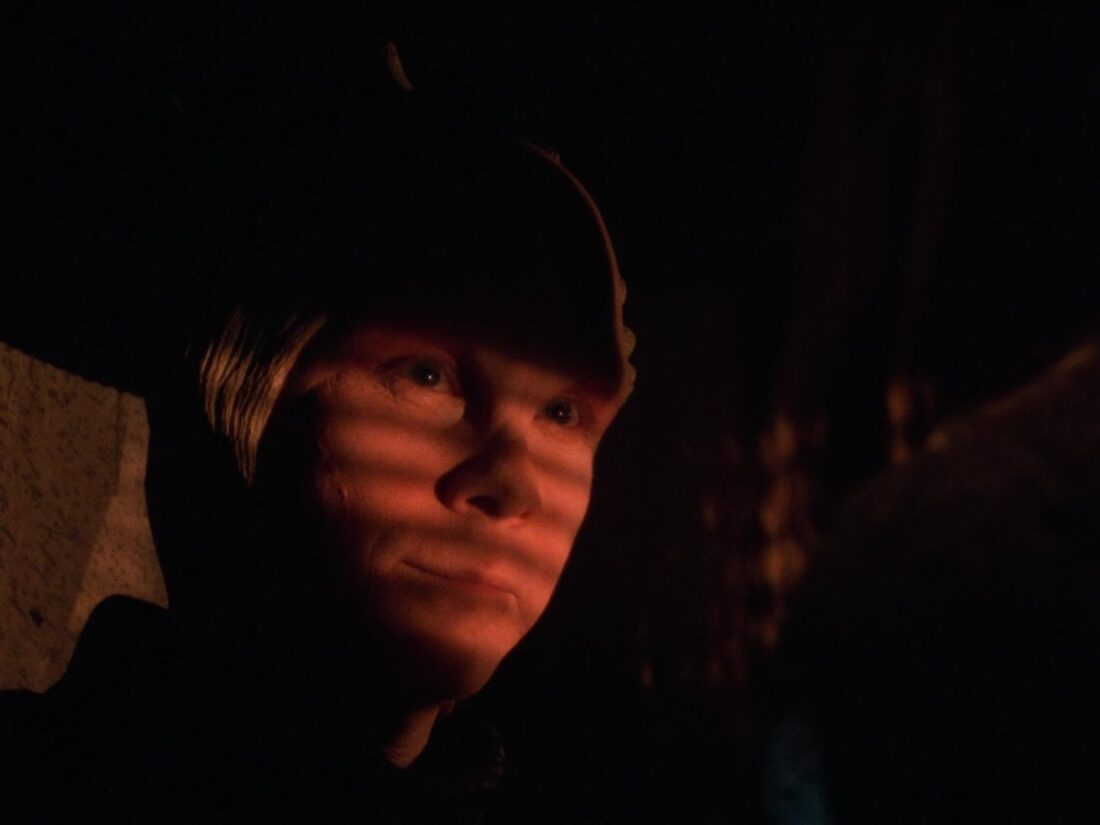
I was looking at the episode screencaps and the Lennier shots look absolutely staggering. Vejar makes that fighter cockpit look truly claustrophobic, and that shot of Lennier partially hidden in the shadows looks fantastic. Vejar really sells the idea that Lennier is treading dangerous ground and edging closer and closer to the darkness. Having a special exclusive (though one-sided) relationship with Delenn and doing things behind Sheridan’s back. Just marvelous. And some of Bill Mumy’s best work in the show’s run. I really like this darker take on Lennier, scar and all.
On the other hand, the Ranger lessons given to Lennier and Findell don’t quite align with the usual Minbari code of honor. Surprising your students by cutting off your fighter’s air supply without warning and having your mothership jump to hyperspace, leaving them behind? The Minbari have always been upfront about their intentions, even approaching alien ships with gunports open as an honor gesture. Maybe it’s only Montoya that does this.
That aside, him and Findell are welcome additions to the show. Spending more time with the Rangers and away from the station is a welcome change. Great performances too.
The climax to Vir’s story can feel a bit cartoonish, but still completely in line with how him and Londo have acted over the past five seasons. Plus, this story also helps to add more to the already to slowly but clearly rising tensions between the Centauri and the Drazi.
And G’Kar and Franklin’s C story is a simple, but effective bit of relief while still adding layers and motion to G’Kar’s arc and his standing with the Narns.
Garibaldi got back on the proverbial wagon in “Phoenix Rising.”
Wouldn’t that be off the wagon?
Regarding Garibaldi’s drunken spell. I don’t think his appearance here is played as a revelation. The thing is, he’s been clumsily trying to keep it a secret. The last time he was openly drunk to people was in season 1, when Sinclair – his friend – was in charge. Sheridan never got to see Garibaldi drunk. And after all the stress they went through last season, it goes without saying he has plenty of reason to keep away from everyone, and the habit hidden. What happens in this episode is he blows it by calling the restaurant for some pizza while clearly loaded. Now someone else on the station knows. These things can get out of hand.
The thing that I don’t like about the bit between G’Kar and Franklin is that, yet again, we have sophisticated humans understanding the deeper truth of an alien religious practice better than the aliens themselves. It’s nice to have a vehicle for G’Kar to express his frustration with the challenges of guiding people to spiritual insight. I just wish that it wasn’t quite so sneering. I’d rather have Ta’Lon around more for that purpose.
I didn’t see it as human vs. alien. I saw it as G’Kar and Franklin having a more complex and nuanced view of religion than the rank and file of either species. And it fits with Franklin’s established practice of Foundationism, so it makes sense that he was the character that was used.
It does fit. But that’s part of the pattern: Franklin gets to have a nuanced and complex view, while the rubes are rubes who insist on definitive (and meaningless) answers to deep questions. Sure, that’s partly just because he’s a main character. But I found it a bit grating for the human to be standing in the doorway passing judgment. It didn’t strike me as the attitude of someone sincerely engaging in good faith in a spiritual inquiry.
Franklin and G’Kar get to have a nuanced and complex view. That’s why it’s not about species. It’s just about how any religious teacher in any culture is inevitably going to have their teachings misunderstood by people who just want simple platitudes or confirmation of their prejudices. Heck, any teacher of any subject is going to have trouble reaching more than a limited percentage of their audience.
I didn’t see Franklin passing judgment there. I saw him meeting G’Kar’s eyes and wordlessly commiserating with G’Kar’s own frustration at his difficulty getting his students to hear what he was trying to say. It’s bizarre to me that you’re erasing G’Kar from this conversation when the entire sequence was about G’Kar and his struggle to be understood, with Franklin only there to give G’Kar a sympathetic ear.
It is certainly not my intention to erase G’Kar. My comment above expressly starts by saying that it is good for the episode to be exploring G’Kar’s frustration. I didn’t think it was necessary to repeat that. It’s a given.
I also don’t disagree that Franklin’s reaction is intended to be sympathetic to G’Kar. That’s also obvious. But I can tell you from personal experience of having made this mistake that it probably wouldn’t be perceived as sympathic by the students. My point is there could have been a better way of exploring these issues without making them the butt of a joke.
However, I concede that the underlying writing issue is more about how the other Narns are (or aren’t) voiced rather than specifically how Franklin is portrayed. This isn’t quite the same as the issues around how the Drazi or the Gaim or the Markab, etc., have been largely stereotyped, because we do have some contrasting perspectives on Narn culture and thought in other episodes (including, as you say, via G’Kar himself). Still, the moment does strike me as having the same reductive aspect. That’s what I was reacting to.
I just don’t see it as a species thing, since it’s a pretty universal point about how the masses misunderstand religion. See Monty Python’s Life of Brian, for example. “Look, you’ve all got to work it out for yourselves!” “Yes! Tell us more!”
Given what we’ve seen Rangers do on the show, the training to become a Ranger would almost have to be incredibly brutal, akin to what Navy SEALs go through. Trust me, by those standards, Montoya went incredibly easy on Findell.
—Keith R.A. DeCandido
Oh, certainly, Ranger training would have to be physically and emotionally demanding. The disconnect that I see here is that (setting aside that a lot of current human basic military training is at least somewhat abusive) military training is in the context of a group, is meant to promote physical fitness and readiness, and is meant to build loyalty within the group and loyalty to the military as a whole. Training is to instill cohesion and obedience, and for the Rangers a certain amount of Minbari philosophy as well. That’s not what we see here. What we see here is an absolutely minuscule group of trainees who have already been through all that and have been handed to Montoya for some polish and field experience, and that Montoya thinks that the best way to make Findell (who possibly should have been washed out already, but hasn’t been for the sake of TV drama) improve is to incessantly bully him. This has the effect of destroying Findell’s self confidence and any sense of group identity that he had with the Rangers. That, to me at least, is the difference. Montoya’s approach is cruel, personal, and incorrect for the context as presented to the audience, not the more impersonal brutality of basic training.
All that said, I see the intent here and appreciate it. It is meant to show us that Ranger training is harsh and demanding, and to show us the consequences of becoming a Ranger for the ‘wrong’ reasons. It’s a reminder just how much Lennier will lie, although he’ll justify it for noble-seeming reasons, and that his lies are not always as believable as he might think. It’s meant to be a dramatic nudge to Lennier — who is by all appearances the perfect student, is already a highly-trained and accomplished warrior monk, and who should make an exemplary Ranger — that he too needs to step away from the Rangers because he joined for the wrong reasons, and it’s building up to the tragedy that he won’t.
For as much as I’ve written about this one aspect of the episode that rubbed me the wrong way, overall I enjoyed it (as I very much enjoy and appreciate your commentary and the rewatches). It’s a great return to form, and a fantastic Lennier episode overall.
Yes, precisely this. The show has a pattern of characters demonstrating that they understand the nature and consequences of their own tragic flaws, even while acting them out. See, e.g., Garibaldi’s ability to give Franklin, among others, good and sincere advice about addiction but then viscerally reject the same advice when it is returned to him.
So Findell is the object lesson to demonstrate that it’s not (yet) too late for Lennier. The tragedy is that, so far, the only one who really knows, or ought to know, that Lennier needs that kind of intervention is Delenn and, for some reason, she refuses to see it.
Trying to look at this through a Minbari lens, I wonder if the point of these exercises was to help Findell see that he was on the wrong path. Something that should have already occurred to him, but he was too stubborn or dense to see.
Just tell him, “Sorry kid, you don’t have what it takes,” and he’ll grumble and fester and may go somewhere very dark. Get him to realize he’s not cut out for it, and he can be nudged onto a better and still useful path.
Montoya’s methods seem brutal, but we haven’t seen all the other attempts to get him to wise up. This is a whack upside the head with a clue-by-four so he’ll finally figure it out.
All well and good, if it hadn’t entailed driving him to the point of attempted suicide. I think that invalidates any argument that this was a calculated psychological ploy based on understanding of his character.
I don’t really disagree, though I don’t see it as a calculated psychological ploy as much as simply an attempt to make it clear to him that he doesn’t have what it takes. You also have to take Minbari/Ranger attitudes towards death into account. It’s not the end; he’ll be reborn as Minbari or human, and maybe he’ll make a better go of things next time around.
And my point is that, whatever the intent may have been, it was a harmful decision to treat him that way, because it almost drove him to self-destruction rather than “teaching” him anything. Results matter more than intentions. So I’m not sympathetic to any attempt to rationalize it or let Montoya off the hook by arguing that he meant well.
It could still have been a calculated psych ploy that still went wrong. Both Montoya and Lennier knew something was off with Findell, but that doesn’t mean they knew he was affected enough to the point of suicide. Commanding officers can still make honest mistakes when analyzing their recruits. It’s not unlike the first act of Full Metal Jacket. The D’Onofrio character goes through the same initiation ritual as the other recruits – full of hazing and bullying. They assume he can handle it because almost everyone does – that’s their method. Until he doesn’t, and he kills himself, and it collapses the credibility of the institution (which they try to play down and minimize afterwards)
That’s what I meant — if it was calculated, it was miscalculated. Also, even aside from Lindell’s suicidal tendencies, the asteroid-field obstacle course seemed absurdly dangerous for a training exercise.
Although I do give the episode credit for at least trying to handwave the Standard Impossibly Dense Han Solo Asteroid Swarm as a result of recent planetary destruction, rather than just assuming that’s what asteroid belts are actually like the way most screen sci-fi does. Although the throwaway line about Jovian planets being destroyed just raises further questions (were they blown up in the Shadow War?). It might’ve been simpler just to make it a planetary ring system like Saturn’s, which is the only thing remotely close to a Han Solo Asteroid Swarm (although much flatter, so it would be easy to get out of, and mostly consisting of smaller particles somewhat more widely spaced).